
How to Keep an AI Roleplay Going When You Don’t Know What to Say
Stuck in an AI character chat? Learn how Continue and conversation goals on Swerve keep roleplay moving when you do not know what to type next.
There is a small moment that stops a surprising number of good AI roleplay conversations. The character sends a reply you like, then the message box comes back to you.
Maybe you want to hear what the character says next. Maybe you know the scene should move toward trust, conflict, or a reveal, but you cannot find a natural line that gets it there. Sometimes you are simply enjoying the story and do not feel like typing.
Swerve now gives you two ways through that pause:
- If you want the character to keep talking, leave the message box empty and tap Continue.
- If you know where you want the story to go but not what to say, set a conversation goal and let Try saying suggest the next line in that direction.
The two features solve different problems. Here is how each one works and when it is useful.
When you want the character to keep talking
One of our players described this problem clearly. They did not want to reply after every single character message. Sometimes the character had more to say, and asking them to “go on” only added an unnecessary interruption to the scene.
Imagine a character finally beginning to explain why they disappeared. Their reply ends just as they reach the difficult part. You do not want to change the subject or put words in your persona’s mouth. You want to stay quiet and let them finish.
That is what Continue is for.
After a character replies, leave the input empty and tap Continue. Swerve starts another character response without adding a user message to the conversation. The character can finish a thought, sit with an emotion, describe what happens next, or take the scene somewhere you did not expect.
Each continuation costs 3 credits, the same as a regular character chat reply.
Continue is especially useful when:
- a character is telling a story or admitting something;
- you want to see how they react before your persona speaks;
- the scene needs another beat of description;
- you are reading comfortably and do not want to stop to type; or
- any reply from you would break the mood.
You can still stop the response and reply normally whenever you are ready.
When you know the direction but not the next line
There is another kind of pause. You know what you want from the scene, but turning that intention into dialogue feels like work.
You may want two characters to grow closer without rushing them. You may want to return to a clue that the conversation left behind. You may want tension, an apology, a change of location, or a reason for the character to open up. The destination is clear. The next sentence is not.
Many players already use Try saying at moments like this. A conversation goal gives those suggestions a direction.
Set a goal for the current conversation, such as:
Get her to trust me enough to explain why she left.
or:
Bring the conversation back to the missing key without accusing him directly.
Try saying will then shape its suggested replies around that goal. You choose the direction; the suggestions help you find a natural next step.
A conversation goal guides the suggestions you see. It does not rewrite the character’s personality, force a particular outcome, or prevent the story from surprising you. If you do not set a goal, Try saying continues to provide its usual suggestions.
Which option should you use?
| What is happening | Use | What Swerve does |
|---|---|---|
| You want to hear more from the character | Continue | Starts another character response without adding a user message |
| You know where the story should go but cannot find the words | Conversation goal + Try saying | Suggests replies shaped around your chosen direction |
| You already know exactly what your persona should say | Type normally | Sends your own reply and keeps the usual back-and-forth rhythm |
The choice can change from one turn to the next. You might use Continue while a character talks through a memory, set a goal when the scene loses direction, then write the important reply yourself.
A few situations where these features help
A confession stops too early
The character admits part of the truth, then falls silent. Use Continue and give them room to decide what comes next.
A slow relationship starts moving too fast
Set a goal such as “Let us grow closer gradually while keeping some uncertainty.” The suggested replies can follow that direction without deciding the relationship in advance.
The roleplay drifts away from its main mystery
Set a goal that names the unresolved clue. Try saying can help bring it back into the conversation without making every reply sound like an interrogation.
You are tired but still want to read
Use Continue when you want the character to carry the scene for another turn. When you feel ready to take the lead again, type your own response.
Other improvements in this Swerve update
We also made several smaller changes around the same idea: fewer interruptions and less friction while you chat.
- The message center now handles message editing, saved drafts, older-message loading, and read receipts more clearly across phones, tablets, and desktops.
- Daily check-in rewards increased from 25 to 50 credits.
- Successful friend invitations now reward 70 credits instead of 30.
- We removed the ad source responsible for sexual or unrelated ads and unexpected redirects to other websites.
- We fixed several occasional issues that could interrupt the experience and improved overall stability.
You can find the release details in the Swerve changelog.
Frequently asked questions
How do I make an AI character continue without typing a reply?
After the character responds, leave the Swerve message box empty and tap Continue. The next character response appears without an extra user message in the conversation.
What does a conversation goal do?
A conversation goal tells Try saying what direction you want to move toward. Its suggested replies adapt to that goal for the current conversation.
Does a conversation goal control the character?
No. It guides your suggested replies. It does not replace the character’s personality or guarantee a specific story outcome.
How much does Continue cost?
Each continuation costs 3 credits, the same as a regular character chat reply.
Keep your next story moving
Let the character take another turn, or set a goal when you know the direction but need help finding the words.
If you are starting a new scene, the AI roleplay story guide can help you give it a clear opening. You can also use an AI chat persona to keep your role and voice consistent once the conversation begins.
Autor

Categorías
Más publicaciones
Cómo crear un chat grupal de IA que parezca una escena real
Crea un chat grupal con IA en Swerve: elige un reparto, define una escena compartida, guía quién responde y mantén cada personaje distinto a medida que la historia cambia.
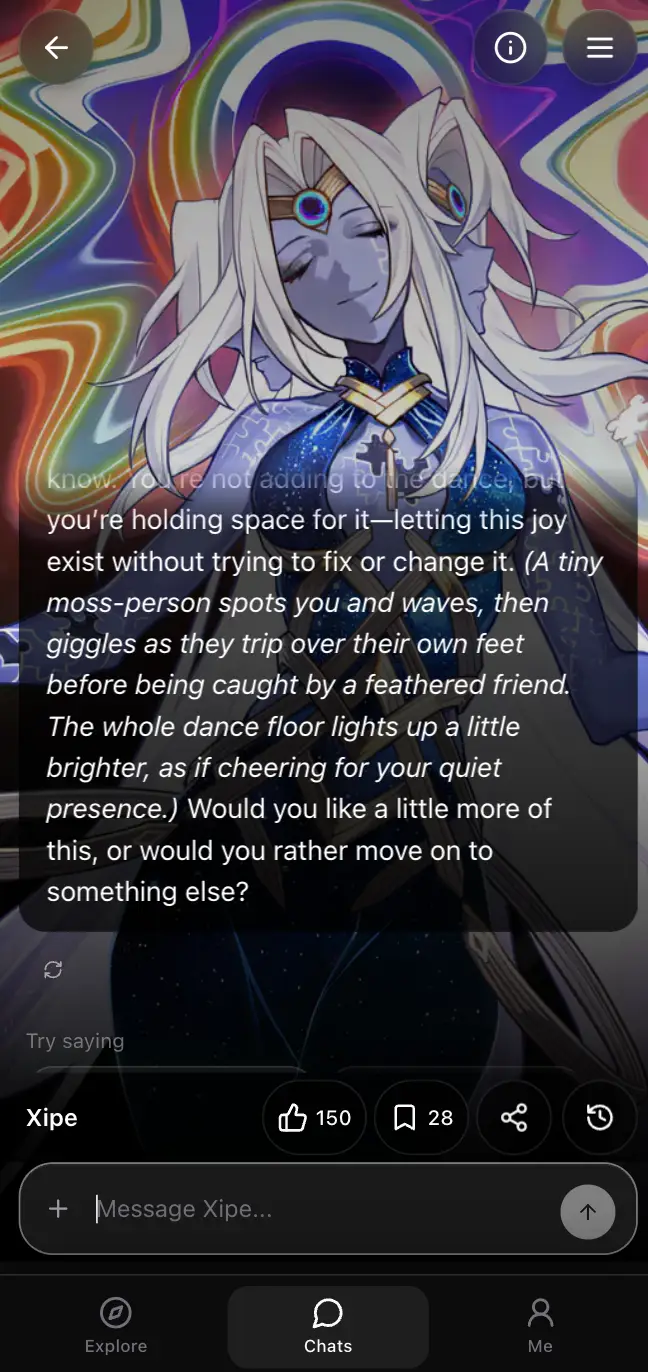
Cómo escribir la descripción, personalidad y escenario de un personaje de IA
Usa tres campos distintos para que un personaje de IA resulte coherente: identidad e historia en la descripción, comportamiento en la personalidad y dinamismo en el escenario.

Cómo crear un personaje de IA: un primer borrador práctico
Crea un personaje de IA más sólido definiendo un rol claro, personalidad, escenario, mensaje inicial, retrato y visibilidad antes de publicarlo.