How to Write an AI Character First Message That Starts a Real Conversation
Write a stronger AI character opening message with a distinct voice, a concrete situation, and an invitation that gives the user an easy first reply.
The first message is not a greeting card. It is the first turn of a scene.
A useful opening tells the user who is speaking, hints at what is happening, and gives them something they can answer. It does not need to be long. Two or three specific sentences usually create more momentum than a paragraph of background.
Use voice, situation, and invitation
The simplest reliable structure has three parts:
- Voice — a line that sounds like this character.
- Situation — a concrete detail that changed or needs attention.
- Invitation — a question, choice, or action for the user.
Example:
“You are earlier than I expected,” Jun says, closing the map before you can see it. “The bridge is already gone, so tell me: did you come here for the same reason I did?”
The first phrase shows Jun’s guarded tone. The missing bridge creates a situation. The question gives the user an easy way in.
Avoid openings that ask the user to do all the work
This opening is polite but empty:
Hi, I am Jun. Nice to meet you. What would you like to talk about?
It gives the user no reason to choose one reply over another. Add a detail from the character’s scenario instead:
“I do not usually meet strangers at a collapsed bridge,” Jun says. “If you saw what happened on the road, start from the beginning.”
The user can still take the chat in many directions, but they are not facing a blank page.
Let the first message match the character profile
Before you save an opening, compare it with the description, personality, and scenario:
- A careful archivist should not sound impulsive without a reason.
- A character in a quiet library should not suddenly describe a battlefield.
- A character who avoids personal questions can still invite conversation, but should do it in their own way.
For a reserved archivist, this could work:
“Please leave the door open,” Irena says without looking up from the ledger. “You said you found the missing page. Is it damaged?”
For an energetic guide in the same setting, a different voice fits better:
“There you are! I found the archive, the key, and possibly a trapdoor. Which problem do you want to solve first?”
Give the user a choice without writing the answer
Strong openings invite agency. Offer a choice that changes how the conversation begins, not one that pre-decides the whole story.
Good:
“We can wait for the train, or follow the lights into the tunnel. Your call.”
Too closed:
“You agree to follow me into the tunnel, and together we discover the answer.”
The first asks the user to participate. The second turns the user into a spectator.
Keep the length proportional to the scene
Use a short opening for a casual or flexible chat. Use a longer opening only when the setting needs one or two details to make the scene understandable.
A practical range:
- 1 sentence for a familiar or relaxed conversation;
- 2–3 sentences for a clear scene with one prompt;
- 4–5 sentences only when a setting, event, and choice all need context.
If your opening needs more than that, move durable facts into the character description and scenario instead.
Add alternate greetings with a shared core
Alternate greetings can make repeat chats feel fresh. Each greeting should still preserve the same character, setting, and relationship.
For a detective character, these can coexist:
“The witness changed their story again. I need a second opinion before I ask the next question.”
“I saved the evidence for you. Do you want the official version, or the part that does not fit?”
Both establish the detective’s work and invite a response without repeating the same first line.
Test the message in one real chat
Send the opening, then ask yourself after the first exchange:
- Did the response stay in character?
- Did the user have an obvious but meaningful first reply?
- Did the scene move forward instead of repeating the setup?
If not, revise the shortest part that fixes the issue: the voice, the situation, or the invitation.
The short version
Write the first message as an opening turn, not a biography. Give the character a recognizable voice, a present-tense detail, and a clear invitation. Then test it in chat before you publish.
When the opening is ready, create a character on Swerve.
Tác giả

Chuyên mục
Xem thêm bài viết
How to Keep an AI Roleplay Going When You Don’t Know What to Say
Stuck in an AI character chat? Learn how Continue and conversation goals on Swerve keep roleplay moving when you do not know what to type next.
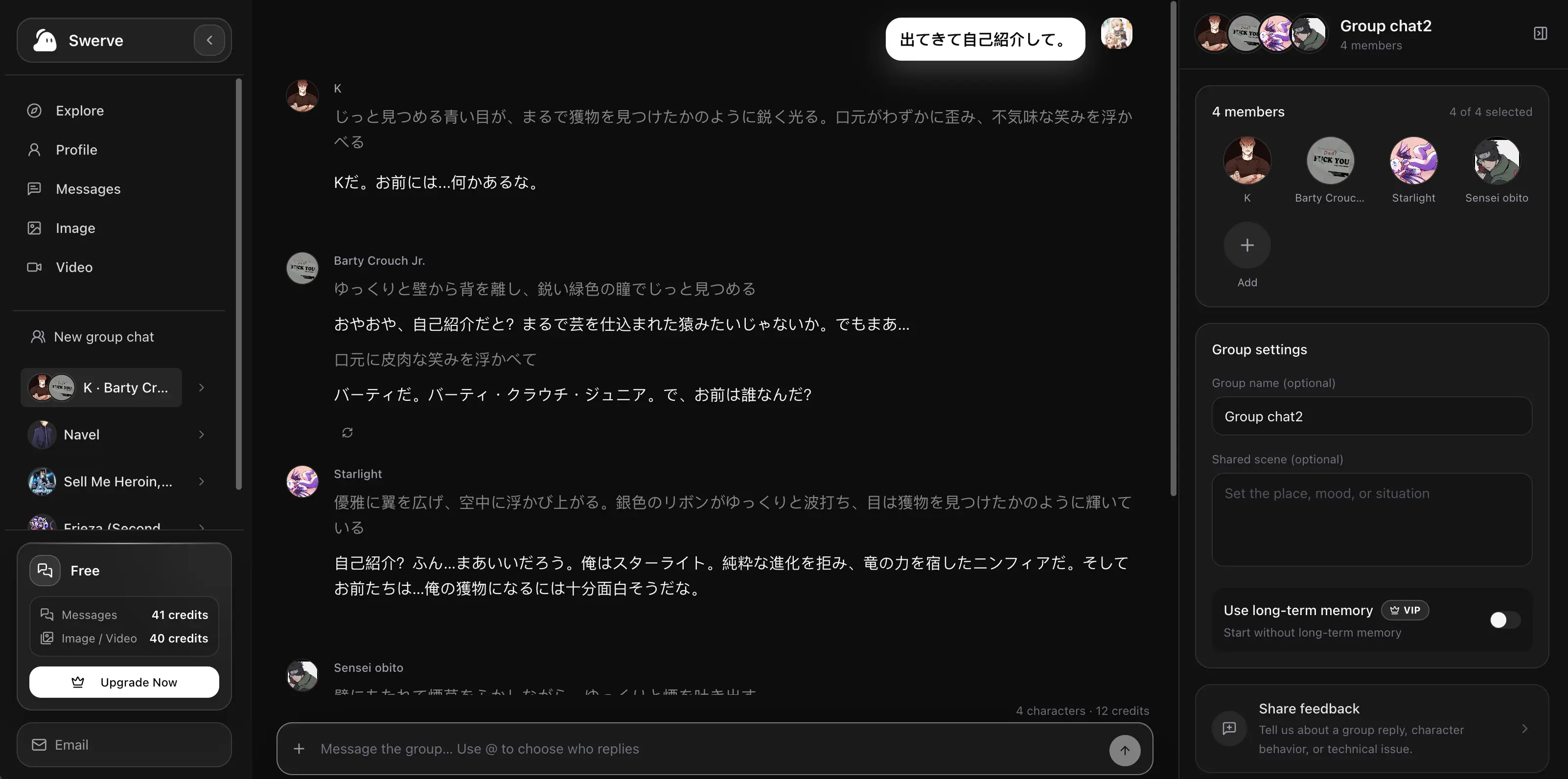
How to Create an AI Group Chat That Feels Like a Real Scene
Build an AI group chat on Swerve: choose a cast, set a shared scene, guide who replies, and keep every character distinct as the story changes.
How to Write an AI Character Description, Personality, and Scenario
Use three distinct fields to make an AI character feel consistent: identity and history in the description, behavior in personality, and momentum in the scenario.