
How to Start an AI Roleplay Story Without Overwriting the Whole Plot
Learn how to open an AI roleplay story with a clear situation, character motivation, tension, and an easy first choice that keeps the conversation interactive.
The best AI roleplay openings do not explain an entire fictional world. They create one clear moment that gives both you and the character something to do next.
A useful opening usually answers four questions:
- Where are we?
- What just changed?
- What does each character want?
- Why does someone need to respond now?
Begin with a moment, not a history lesson
Worldbuilding matters, but it should support the first interaction.
This opening makes the reader process background before anything happens:
The kingdom was founded 800 years ago and has passed through seven dynasties, three civil wars, and a long period of trade reform.
This version turns the same world into a playable scene:
The palace gates close behind you. The treaty in your pocket carries the seal of a kingdom that officially stopped existing 800 years ago.
You can reveal history later through questions, discoveries, and character reactions.
Use the four-part opening pattern
Write one or two sentences for each part.
1. Place
Choose a location with something characters can notice or use:
- an empty train platform after the final service;
- a library room with one shelf left unlocked;
- a crowded festival where two characters cannot speak openly;
- a research station during a communications failure.
2. Change
Something should be different from a normal day:
- a message arrives from an impossible sender;
- a trusted object goes missing;
- a stranger knows the player’s name;
- the group receives two conflicting instructions.
3. Motivation
Give each important character a reason to care:
- one wants the truth;
- one wants to protect a secret;
- one wants to leave;
- one needs the group to stay together.
Motivations can conflict without making a character openly hostile.
4. Invitation
End with an action, question, or choice:
The station lights flicker. Mara holds out the unopened message. “Do you want to read it here, or somewhere the cameras cannot see?”
The user can answer immediately, and the AI character has enough context to continue.
Give characters motives, not scripts
Avoid deciding every future action:
Mara will betray the group in chapter three and then apologize after the battle.
Instead, define pressure and uncertainty:
Mara wants the group to survive, but she is hiding an agreement that could make the others stop trusting her.
The second version produces more natural conversation because the betrayal is a possibility rather than a required checkpoint.
Keep the first cast small
Even if the story will eventually include a large group, begin with one to three active characters. A crowded opening makes it harder to establish distinct voices and motivations.
For each starting character, write:
- what they want right now;
- what they know that others do not;
- how they tend to respond under pressure.
Example:
| Character | Wants | Knows | Under pressure |
|---|---|---|---|
| Mara | Get everyone off the station | The message is partly forged | Becomes very precise |
| Ivo | Prove the message is real | The sender used an old code | Makes reckless tests |
| Player persona | Find a missing friend | The friend used the same code | Asks direct questions |
This is enough structure for a strong first scene.
Make the player’s role clear
An AI roleplay story works best when the user knows what authority and knowledge their persona has.
Clarify whether the player is:
- an outsider discovering the setting;
- a member of the group with shared history;
- a leader who can make decisions;
- a witness with limited information;
- a rival whose goals partly conflict with the character.
If you need help defining that identity, use the AI chat persona guide.
Use constraints that create choices
Good constraints make the scene easier to play:
- the train leaves in ten minutes;
- only one person can enter the archive;
- the group cannot contact anyone outside;
- telling the truth would reveal another secret.
Avoid constraints that remove agency:
- the player cannot speak;
- every decision has already been made;
- the character ignores all user choices;
- only one answer can continue the story.
The goal is pressure, not a predetermined solution.
A starter template
Setting:
[A specific place with one useful detail.]

What changed:
[The event that interrupts normal life.]

Characters:
- [Name] wants [goal] but is hiding [fact].
- [Name] wants [goal] and believes [assumption].

Player role:
The player is [role] and knows [relevant fact].

Opening:
[Two to five sentences ending in an action, question, or choice.]
Revise after the first exchange
Do not try to perfect the entire story before chatting. After the first few replies, ask:
- Are the character voices distinct?
- Is the immediate problem understandable?
- Does the player have meaningful choices?
- Is the AI repeating background instead of moving the scene?
- Is an important fact missing from the persona or memory?
Adjust only the information causing the problem. Small corrections usually preserve the energy of the opening better than restarting with a much longer prompt.
The short version
Start with a place, a change, a motive, and an invitation. Let background emerge through conversation, and define enough tension to create choices without deciding the ending.
You can start a new roleplay conversation on Swerve when the opening is ready.
Автор

Категории
Ещё статьи
How to Keep an AI Roleplay Going When You Don’t Know What to Say
Stuck in an AI character chat? Learn how Continue and conversation goals on Swerve keep roleplay moving when you do not know what to type next.
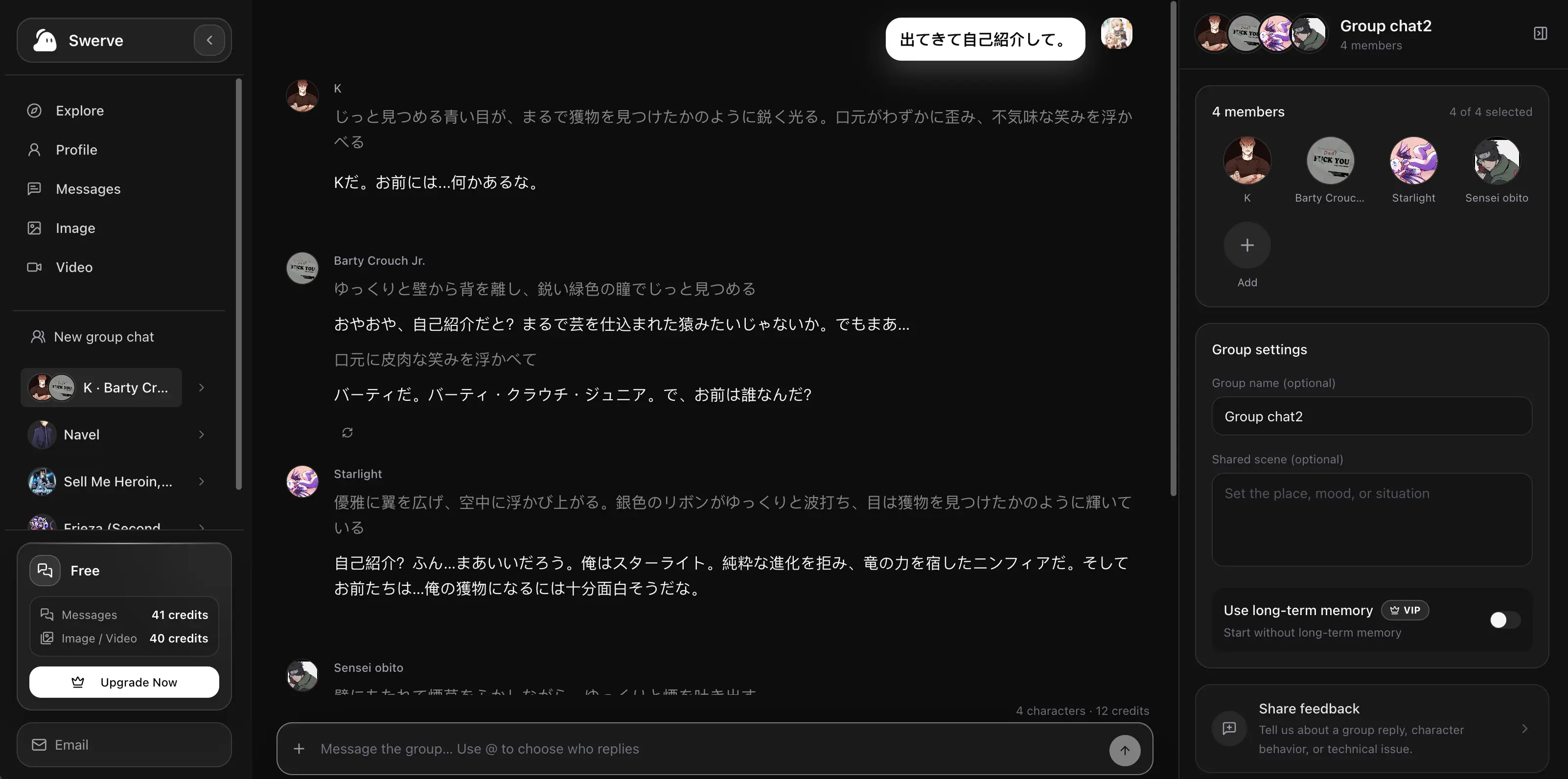
How to Create an AI Group Chat That Feels Like a Real Scene
Build an AI group chat on Swerve: choose a cast, set a shared scene, guide who replies, and keep every character distinct as the story changes.
How to Write an AI Character Description, Personality, and Scenario
Use three distinct fields to make an AI character feel consistent: identity and history in the description, behavior in personality, and momentum in the scenario.