
How to Create an AI Chat Persona That Gets Better Responses
A practical guide to writing a clear AI chat persona with a role, voice, goals, boundaries, and just enough detail for consistent character conversations.
An AI chat persona is the identity you bring into a character conversation. It tells the character who you are in the scene, how you tend to speak, and what kind of relationship or story you want to build.
A useful persona is not a full biography. It is a compact set of details that helps the conversation stay consistent without forcing every reply down one path.
What a persona should include
Start with five pieces of information:
- Name and pronouns — the basics the character needs to address you correctly.
- Role in the scene — friend, investigator, rival, teammate, traveler, student, or another clear relationship.
- Voice — direct, playful, reserved, curious, formal, or another recognizable way of speaking.
- Immediate goal — what you want from this conversation or story.
- Boundaries — themes, tones, or directions you do not want the conversation to take.
These details answer the questions an AI character otherwise has to guess.
Use concrete details instead of broad labels
“Confident” can mean many things. A more useful description explains how that confidence appears:
Rowan speaks calmly, asks direct questions, and rarely backs away from a disagreement.
The second version gives the character behavior it can respond to. The same principle works for quieter personalities:
Mina notices small details, takes time before answering, and uses dry humor when she feels comfortable.
You do not need to list every trait. Two or three observable behaviors are usually more useful than a long string of adjectives.
Give the persona a reason to be in the scene
Personas work better when they contain a current situation. Compare these two openings:
I am an explorer.
I am an explorer mapping a city that disappeared from every official record. I think your character knows why.
The second version creates a reason for the characters to talk. It gives the AI a question, a source of tension, and a direction for the next reply.
Use a simple pattern:
I am [role] trying to [goal], and your character matters because [connection].
Examples:
- I am a new detective trying to understand a locked-room case, and your character was the last person inside.
- I am a diplomat trying to stop an argument between two kingdoms, and your character does not trust my side.
- I am an old friend returning after five years, and your character never learned why I left.
Separate durable identity from temporary context
Some details should remain true across many chats:
- your preferred name;
- pronouns;
- general voice;
- a few stable traits;
- recurring boundaries.
Other details belong only to one story:
- the current location;
- what just happened;
- who knows a secret;
- the immediate objective.
Keep durable identity in a compact roleplay note that you can reuse when starting a new chat. Put temporary story facts in the opening message. This keeps the note useful without making unrelated scenes inherit old plot details.
Avoid over-specifying the outcome
A persona should support interaction, not write the ending in advance.
This leaves room for the conversation:
Kai wants to earn the captain’s trust but is not sure whether the captain deserves it.
This closes too many possibilities:
The captain immediately trusts Kai, reveals every secret, and agrees with every decision.
The first version gives both characters something to discover. The second removes the tension that makes a roleplay conversation interesting.
Add boundaries in plain language
Boundaries do not need to be complicated. Write them as direct instructions:
- Keep the story adventurous rather than graphic.
- Do not include real-world personal information.
- Avoid humiliation themes.
- Ask before changing the relationship into romance.
- Keep conflict fictional and do not present professional advice as fact.
Review the Swerve safety guide for broader expectations around fictional characters, privacy, and reporting.
A reusable persona template
Copy this structure and replace the examples:
Name:
Pronouns:

Role:
I am a [role] connected to the scene through [relationship or situation].

Voice:
I speak in a [tone] way. I tend to [two observable behaviors].

Goal:
Right now I want to [immediate goal].

Useful background:
[Two or three facts the character should know.]

Boundaries:
[Themes, tones, or directions to avoid.]
Keep the first version short. You can add detail after seeing what the character misunderstands.
Test the persona with three messages
Before expanding the profile, try three different prompts:
- a normal introduction;
- a disagreement or unexpected event;
- a question that depends on your persona’s background.
Then check:
- Did the character address you correctly?
- Did it understand your role?
- Did the tone feel natural?
- Did it respect the stated boundaries?
- Did the conversation leave room for you to make decisions?
If one answer is no, edit the smallest relevant part of the persona. Do not rewrite everything at once.
The short version
A strong AI chat persona is clear, observable, and open-ended. Give the character enough information to understand who you are and why you are present, but leave the relationship and story free to change through conversation.
When you are ready, use the note to start a character chat.
Автор

Категории
Ещё статьи

How to Keep an AI Roleplay Going When You Don’t Know What to Say
Stuck in an AI character chat? Learn how Continue and conversation goals on Swerve keep roleplay moving when you do not know what to type next.
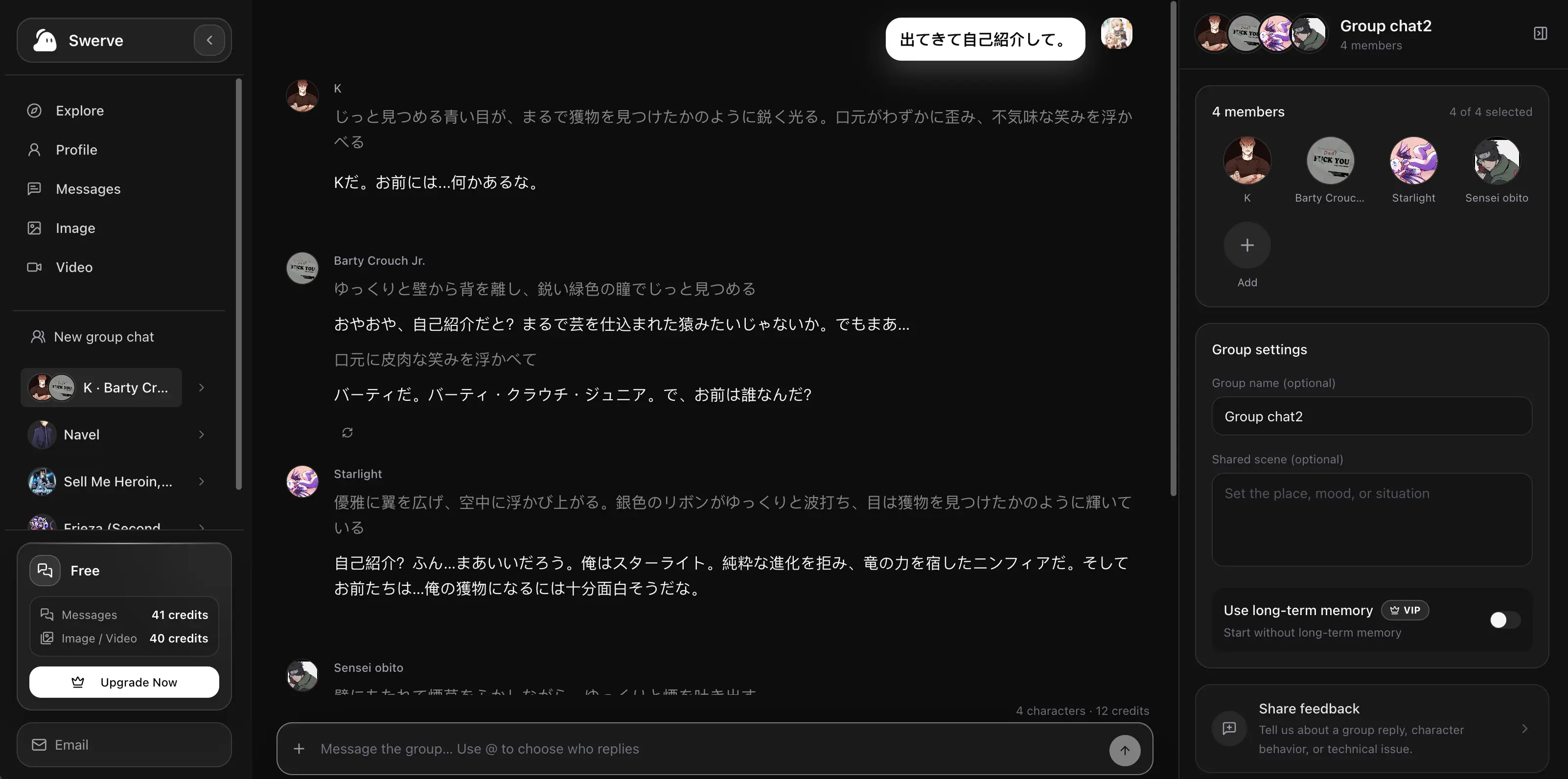
How to Create an AI Group Chat That Feels Like a Real Scene
Build an AI group chat on Swerve: choose a cast, set a shared scene, guide who replies, and keep every character distinct as the story changes.
How to Write an AI Character Description, Personality, and Scenario
Use three distinct fields to make an AI character feel consistent: identity and history in the description, behavior in personality, and momentum in the scenario.